Why Business AI Needs Approved Sources Before Automation
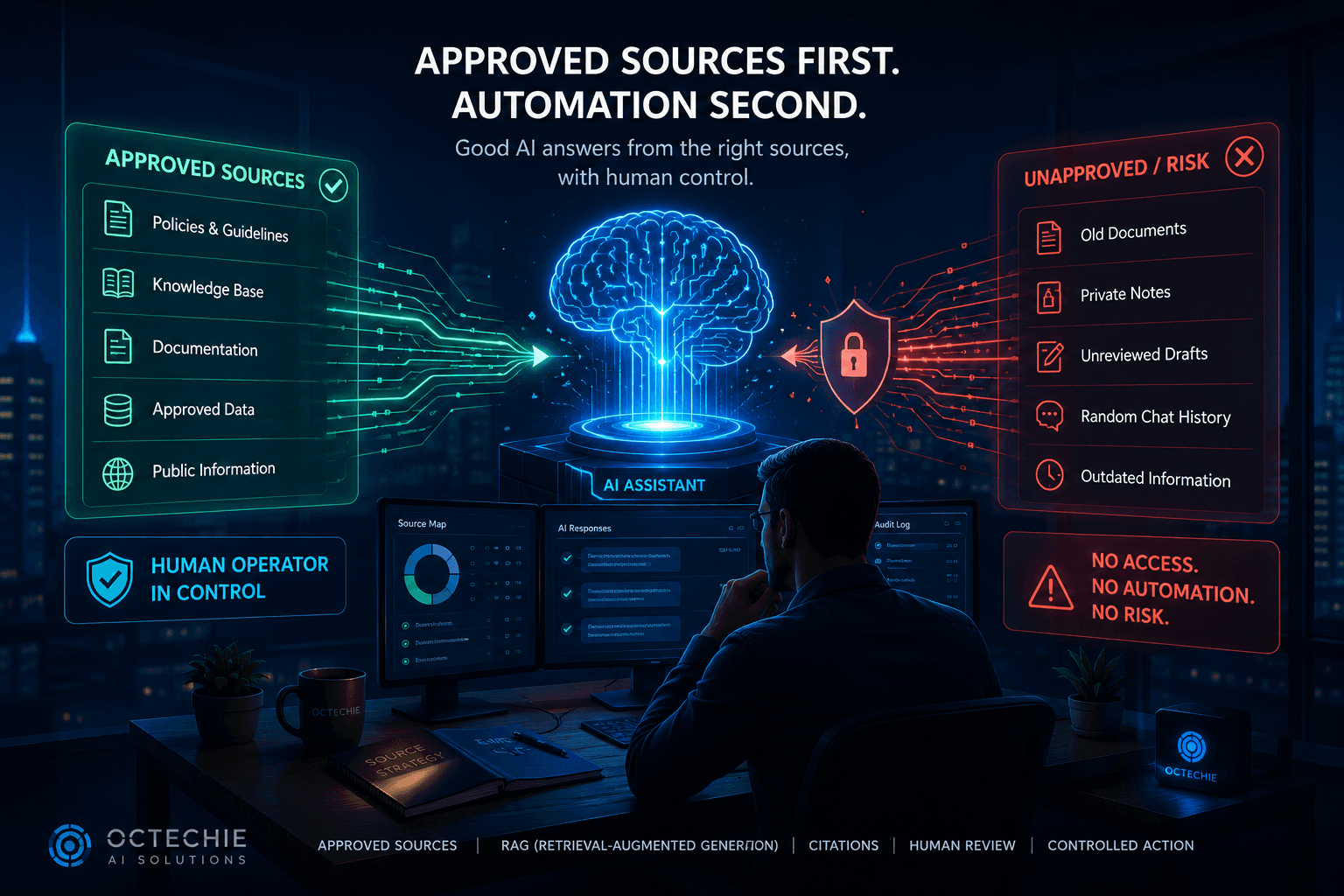
A business AI system should not answer from everything it can access. It should answer from sources the business has approved, inside boundaries a human operator understands.
Most business AI projects start with the wrong question.
People usually ask which model to use, which chatbot to install, or which workflow to automate. Those questions matter, but they are not first.
The first question is: what is this AI allowed to know?
If a business assistant can read from old documents, mixed folders, private notes, stale policies, random chat history, and unreviewed drafts, automation does not make the company smarter. It makes confusion faster.
That is why approved sources matter.
What an approved source means
An approved source is not just a file that exists somewhere. It is a source the business has reviewed and decided the AI is allowed to use for a specific purpose.
A good approved source has an owner, a purpose, a privacy level, a freshness expectation, and a clear workflow scope. It should also be clear whether AI can only read it, summarize it, cite it, or use it to recommend an action.
This is one of the most important differences between a demo chatbot and a real business AI system. A chatbot can answer a question. A business AI system needs to know where the answer came from, whether that source was approved, whether it is still current, and whether a human should review the result before any action happens.
A practical service-company example
Imagine a local service company wants an AI assistant to help answer customer questions.
The company may have a current service list, pricing rules, scheduling instructions, warranty notes, internal operating procedures, old proposals, private owner notes, employee chat history, outdated documents, and unfinished drafts.
If all of that gets mixed together, the AI may sound confident while giving an answer the business never approved.
Allowed for this workflow
- ✓ Current service list
- ✓ Approved pricing rules
- ✓ Public FAQ
- ✓ Scheduling policy
- ✓ Selected internal instructions
Blocked from this workflow
- × Old drafts
- × Private owner notes
- × Unapproved discounts
- × Random chat history
- × Outdated documents
If the source boundary is not clear, the AI can produce fast answers with weak business control. That is not automation. That is risk.
Where RAG fits
RAG means Retrieval-Augmented Generation. In business language, it means the AI does not answer only from the model’s general memory. First, it retrieves relevant information from a knowledge source, then it uses that information to generate an answer.
RAG is useful because it lets an AI assistant answer from company-specific knowledge: documents, policies, notes, manuals, FAQs, transcripts, or other business sources.
But RAG does not solve the source problem by itself. If the AI retrieves from the wrong source, the answer can still be wrong. If it retrieves from private material, the answer can create a privacy problem. If it retrieves from old documents, the answer can look correct but still be outdated.
That is why the approved-source layer must come before automation.
Citations help, but they are not enough
Citations are important. A citation can show where an answer came from. That helps the operator review the answer, check the source, and understand why the AI responded the way it did.
But citations are not the full system. A citation tells you where the answer came from. Approved sources tell you whether the AI should have used that source at all.
Practical AI governance
The foundation is not a giant policy document. It is a source map: a clear boundary between approved knowledge, private material, stale information, unreviewed drafts, and actions that require human approval.
The operator still matters
At OCTechie, we do not think about business AI as “connect AI to everything and hope it works.”
We think about AI implementation as a controlled operating system: approved sources, retrieval rules, privacy boundaries, human review, action control, logs, proof, and operator visibility.
“Even if you build with AI assistance, you still need to understand what you are building. AI is a tool, not a magic wand.”
That is the difference between using AI as a toy and implementing AI as part of real business operations.
A simple starting checklist
A practical first AI implementation does not need to be huge. Start with one workflow: customer inquiry handling, internal knowledge search, sales FAQ support, call summary review, document lookup, or social content preparation.
- Which sources are approved for this workflow?
- Who owns those sources?
- Which sources are public, internal, or private?
- Which documents are outdated or draft-only?
- Should the AI cite the source?
- Can the AI act, or only suggest?
- Where does human approval happen?
Once those answers are clear, automation becomes much safer and more useful.
The real first step
Most businesses do not need to start with a huge AI platform. They need to start with a controlled first workflow.
Pick one use case. Define the approved sources. Add retrieval rules. Require citations where useful. Keep the human operator in control. Only then connect automation.
Before you automate with AI, decide what the AI is allowed to know. Everything else depends on that.